
Rather listen? Simply hit the play button and listen to the article in full
- Pensioner Power: the Pensioner Magazine Spring Issue 00:00
David Hencke spells out the ongoing impact of older voters on pensions and the political agenda
Pensioners have enormous potential power and influence in the UK and politicians must take note of them. There are 12.9 million pensioners in the UK – at 19% of the total population, they are one of the nation’s largest groups. And in an ageing society, their numbers are growing. In less than 50 years, according to the Office for National Statistics, 8.6 million more people will become pensioners – taking the share to 26%.
But pensioners are not a homogenous group. They don’t even now get the same rate of state pension. The majority – 8.57 million – are still on the lower pre-2016 pension, topped by a complex system of additional payments depending on when they were contracted in or contracted out of the old state earnings-related pension scheme (SERPS).
A minority – 4.38 million – are on the new state pension, currently £230.25 a week or £12,005 a year if you have 35 years of National Insurance contributions.
Most of the retired – 12.7 million – top up their state pension with a private pension, either from previous employment or an annuity. But this will change as those benefiting from final salary pensions are replaced by new pensioners getting contributory pensions.
Despite this, a big minority – 1.9 million, according to Age UK – are in relative poverty and 1.36 million have no pension savings but rely on pension credit benefit.
Political will
Politicians have to take account of the power of pensioners when designing policies. If they do not, the results can be disastrous, as Labour found out when it rushed through plans to scrap the winter fuel allowance for all those not on pension credit within weeks of winning a huge majority at the last election.
The scheme, which meant anybody earning more than £11,300 a year lost a £200 or £300 allowance, certainly contributed to Labour plummeting in the polls. It not only registered with the pensioners, but also with relatives unhappy to see grandma or grandpa having to cut back on heating their home.
The decision was taken without an impact statement or checking with the Social Security Advisory Committee, which advises the Department for Work and Pensions on benefits. The policy had to be reversed after MPs were flooded with complaints from voters, restoring the allowance to those whose income is less than £35,000 a year. But the damage was done and so far Labour has not recovered.
Triple-lock boost
Pensioners benefit from the decision in 2010 by the Conservative/Liberal Democrat coalition government to implement the triple-lock – allowing pensions to rise every year in line with prices, wages or by 2.5%, whichever is highest. The origins of the triple-lock followed a 10 percentage point drop in the value of the state pension compared with wages between 1979, when Margaret Thatcher was elected, and 2010. It fell from 26% to 16% because it was only linked to prices by the Tories and Labour.
Pensioner power has meant all the main parties who have governed – Conservative, Labour and Liberal Democrat – have pledged to keep the triple-lock despite the cost every year rising rapidly.
It is estimated it will cost £15.5 billion by 2030 – three times the original estimates – and that the annual pension bill will rise from 5% of GDP now to 7.7% by the 2070s.
Reform UK, which is riding high in the polls, has so far not commented on whether it will retain the triple-lock.
The cost has sparked an intergenerational debate on whether too much is being given to pensioners – many of whom also have private pensions – while young people are not being supported, face student debts and huge rents, and often cannot afford to buy their first home.
The average UK state pension lags behind money paid to pensioners in many European countries, who have a higher standard of living. It is increases delivered by the triple-lock that are beginning to make up the difference.
Successive governments have also highlighted the increases given to people on the new state pension, who are still in a minority. It is not as high for those on the old pre-2016 state pension because their basic pension tends to be lower.
If Reform decides not to retain the triple-lock, the party is likely to run into opposition with their main area of support.
The collapse of the Tory vote during the last general election continues and has had a profound effect on the pensioner vote. Despite a marked fall in support among the young in the 2024 election, 41% of men and 42% of women over 65 still voted Conservative.
But by October 2025, polls showed Reform UK leading among the over-65s – 31% supported Reform compared with 23% for Labour. The Tory share was even lower.
This means Reform will need to keep its support among pensioners, who vote more regularly than young people, if it wishes to become the next government in 2029 or 2030. If it does not support the triple-lock, or says it will modify it, that support is likely to disappear.
Certainly, in places where Reform has won councils, the party is trying to curb some public service pensions for local government workers and firefighters, which is hardly going to be popular.
It is interesting that Nigel Farage, who has announced Trump-style policies on immigration, has maintained his silence on the future of the state pension. He will not be able to do so going into an election.
Campaign failures
Not every campaign by pensioner groups has resulted in the government conceding to their demands.
The biggest group that has failed to move either the Conservative or Labour governments has included the 3.6 million pensioners born in the 1950s who bore the immediate brunt of the raising of the pension age from 60 to 66.
The Women Against State Pension Inequality (WASPI) suffered a huge blow in January when the government said it had reconsidered their case but ruled out paying any compensation.
Work and Pensions Secretary Pat McFadden told the House of Commons the government accepted that “individual letters about changes to the state pension age could have been sent earlier”. But he added: “Women did not suffer any direct financial loss from the delay.”
In 2024, a parliamentary ombudsman had recommended compensation of between £1,000 and £2,950 each for those affected. However, it could not enforce the payment and the government rejected it. The ombudsman had found that there had been partial maladministration over the implementation of the scheme.
Any plan to compensate the women fell away as long ago as 2019 when former Labour leader Jeremy Corbyn was defeated in the general election. His shadow chancellor, John McDonnell, promised £60 billion to settle it – but the offer came too late in the election campaign to have any impact.
There is speculation that the present government may postpone plans to raise the pension age from 66 to 67 by 2028. The argument is that rising longevity, which grew rapidly before 2010, has levelled out and even slightly reversed following the Covid pandemic, so there is no need for such a rise.
Much will depend on the health of the National Insurance fund that pays the present generation of pensioners, however. The argument against raising the state pension age is that the fund is often raided by ministers to pay for other areas, including reducing government debt. And given the present financial stringency and the need for higher taxes, it could be vulnerable to another raid.
Pensioner voting power has had enormous success in securing rises for the new generation of state pensioners, but in the long term this may falter. The ever-growing increase in costs to fund pensions in the 2030s and 2040s could force a future government to modify it.
And the experience of 1950s-born women in their quest for justice shows that Labour is as adept as the Conservatives at fending off claims for compensation.
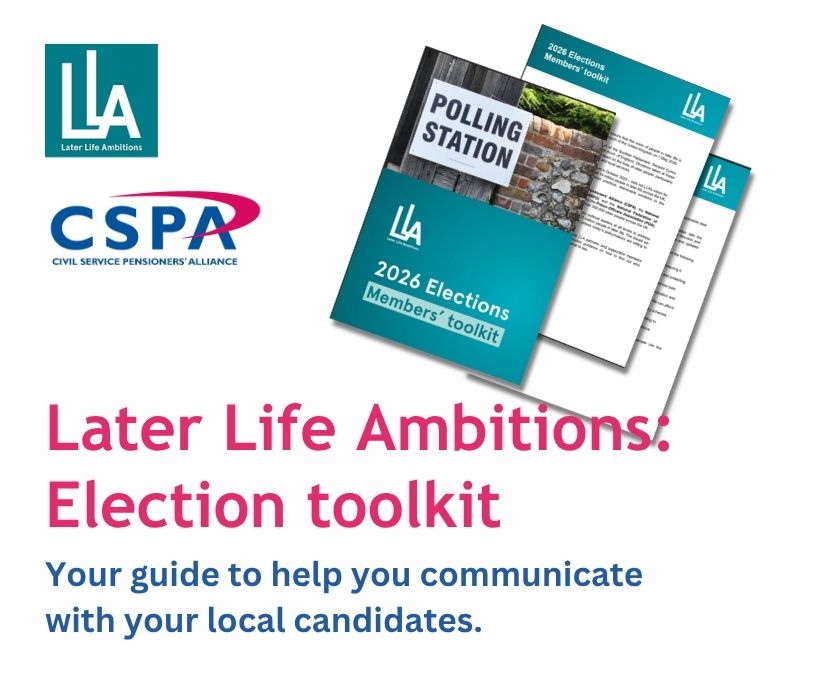
With major elections taking place across Great Britain on 7 May 2026, Later Life Ambitions, has produced a practical toolkit to help members and supporters ensure the voices of people in later life are heard.