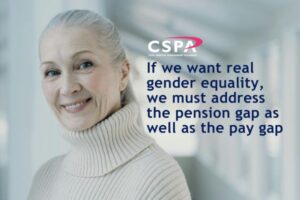
International Women’s Day, marked each year on 8 March, is a time to celebrate the achievements of women while also highlighting the inequalities that persist in society. Two recent reports have drawn attention to one such issue in the UK: the significant disparity in pension income between men and women in later life. Their findings show that, despite progress in some areas, many women still face greater financial insecurity in retirement than men.
In March last year, a report from Age UK, entitled “Older Women in the UK – Building a picture of older women’s lives”, maintained that we were much further from the “progressive society” which wouldn’t tolerate gender inequalities than we might think. Women tend to live longer lives than men do, but they are also more likely to be disabled and suffer from long term health conditions and poverty in later life.
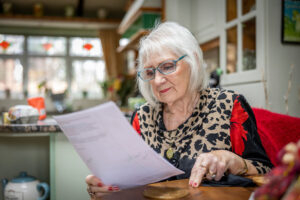
In the run up to, and in the years after, the State Pension Age, older women are more likely than men to be poor than older men, especially if they live alone. There are many reasons for this, of course, including time off work due to caring responsibilities and ill health, women being more likely to work part-time, greater Pay Gaps historically, and much lower retirement savings pots across both occupational pensions and personal pensions for women.
Another important report, “Women and Pensions in the UK”, issued by the Women’s Budget Group (WBG) in January 2026, said that “the current pension system is dysfunctional and unfair” and that, “without reform, pension inadequacy and inequality are baked into ever age cohort’s future.” The WBG has made key recommendations to the Government’s recently convened Pensions Commission, citing the Department for Work and Pensions’ own data which shows that 57% of pensioners in poverty are women. Women are more likely than men to have no private (or occupational) pension wealth at all, making up 58% of those who are entirely reliant on income from the State and State Pension.
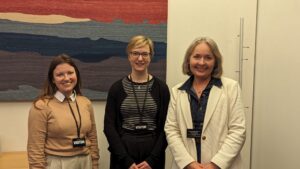
CSPA General Secretary, Sally Tsoukaris, said
“We frequently hear that the State Pension Triple Lock commitment is unsustainable or unaffordable in the long term, but we must remember that our State Pension is well below that of many other countries in the Developed World. It is set to be set on the basis that most people in the UK have additional income from their occupational or personal pensions, but the stark reality is that for a great many people, and more so for women, their private pension arrangements are well below what is needed to support a decent living in retirement, with all too many having no pension savings at all. This is a ticking time bomb that the Pensions Commission must address.
The WBG report recommends that the Pensions Commission should take account of the impact of social care, health, housing tenure, unpaid work and the balance between state and private pension provision when determining pensions adequacy and evaluating women’s pension needs. The Commission should also look at the adequacy gaps across both defined benefit (DB) schemes, largely public sector, and defined contribution (DC) schemes, commonly offered in the private sector. The report says that the Gender Gap is narrowest in State Pensions and widest in DC schemes, which dominate private pension scheme provisions.
The Pensions Commission needs to set out the adequacy of the State Pension for those who rely solely upon it in retirement, the majority of whom are women, and should also reflect the need for both state and private pension design to take account of current employment patterns and practices, such as multiple and part-time employment, which are more common amongst women.
The Age UK report points out that the new State Pension, introduced in April 2016, corrected much of the gender inequality for people reaching State Pension Age from that date onwards, however, the DWP has estimated that the gender disparity in the State Pension will not be eradicated until 2041.
There have also been particular impacts for 3.8 million women born in the 1950s, due to the increase in the State Pension Age, which the Parliamentary and Health Service Ombudsman has said meant that “some women lost opportunities to make informed decisions about their finances”, which has led to injustice.