

The UK’s banking system is currently undergoing mass transition. Amidst this, the question of financial exclusion looms large. Despite assurances to the contrary, the accelerated disappearance of banks off the high street has left many older people further isolated from Britain’s economy than ever before.
According to Which?, bank branches in the UK are disappearing at a rapid rate, with approximately 53 to 54 branches closing every month. Since January 2015, over 6,600 branches have shut down, representing nearly 68% of the entire network that existed a decade ago.
The consequences of this rapid transformation are huge, particularly for those in later life. In a 2025 report on acceptance of cash, the Treasury Committee warned that the UK is “sleepwalking” into a two-tier society where those who cannot pay or bank digitally are shut out of shops, cafes, and essential services.
With AgeUK finding that approximately 75% of people over 65 with a bank account want to conduct at least one transaction in person at a physical branch, closing bank branches forces older people into digital exclusion, stripping away their independence and leaving them highly vulnerable to scams and “poverty premiums.”
Without face-to-face support, many are effectively shut out of the economy, unable to manage essential life tasks like bereavement or power of attorney. Many working-age individuals also do not bank online or lack nearby banking facilities, and an estimated 1.1–1.3 million people in the UK do not have a bank account at all.
Beyond branch closures, the broader decline in cash access also threatens financial inclusion. LLA emphasises that older and vulnerable people rely on offline options, including ATMs, cashback, and the Post Office, to access cash safely. With over half of those aged 75-plus offline, many cannot bank digitally due to lack of digital skills, security concerns, health restrictions, or difficulty using devices.
Online banking can also expose them to scams: fraud via internet banking rose by 32% in the first half of 2020 compared with the previous year, and sophisticated scams disproportionately target older people. Face-to-face banking staff historically helped detect fraud, but branch closures remove that protection. LLA advocates for businesses to maintain vulnerable client policies, provide one-to-one support and workshops, and offer tools like dedicated hotlines to ensure older people are protected and can safely access cash.
In order to soothe this situation, the Government has committed to the rollout of banking hubs, shared high street spaces designed to replace traditional bank branches, specifically aimed at supporting those who rely on face-to-face services. As of January 2026, over 210 hubs are open across the UK, and the Government has committed to a total of 350 hubs to fill gaps in the banking landscape.
Whilst there has been progress, there is deep concern over the speed and adequacy of the rollout of banking hubs. Bank branches are closing far faster than banking hubs are being delivered, leaving many towns without any face-to-face banking for extended periods.
There are also concerns over the assessment criteria for banking hubs. Link’s current rules for a community to be awarded a hub rely on rigid distance and travel-time metrics that often fail to reflect real-world needs, increasing the risk of financial exclusion and isolation for those with mobility, health, or transport barriers.
Amidst this concerning situation, LLA has been working with parliamentarians to raise concerns about how issues with the rollout of banking hubs disproportionately affect older people, risking their exclusion from Britain’s economy. Having met with multiple MPs from across parties in the House of Commons, LLA has built a coalition working to get answers from government on how and when assessment criteria for banking hubs will be adjusted to reflect real community needs.
LLA also continues to make representations to Government consultations and inquiries, including recent submissions to the Treasury Select Committee’s ‘Acceptance of Cash’ (December 2024) and ‘AI in Financial Services’ (April 2025) inquiries, as well as the DSIT’s Digital Inclusion Action Plan consultation (April 2025).
This work will culminate on 28th April, where LLA will hold a parliamentary roundtable on banking hubs and bank branch closures in conjunction with the Athena Foundation and the APPG for Fair Banking. Including representatives from each major party, the roundtable will also be attended by Link and Cash Access UK – bringing together the key players in the banking hubs rollout to provide clarity and drive action.
Ultimately, the transition of the UK’s banking system must not come at the expense of accessibility. While digitalisation is inevitable, it must be balanced with solutions that reflect the realities of older and vulnerable communities.
LLA’s work has been key in keeping these concerns on the agenda, advocating for a comprehensive approach that ensures cash access, secure banking, and offline support remain available. The upcoming roundtable will be a decisive moment to turn concern into commitment, driving meaningful change so that older people are not left cut off from the UK’s financial system.
Later Life Ambitions
Later Life Ambitions brings together the collective voices of over a quarter of a million pensioners through the National Federation of Occupational Pensioners, the Civil Service Pensioners’ Alliance, and the National Association of Retired Police Officers Association.
We aim to encourage today’s decision makers to confront the challenges of tomorrow.
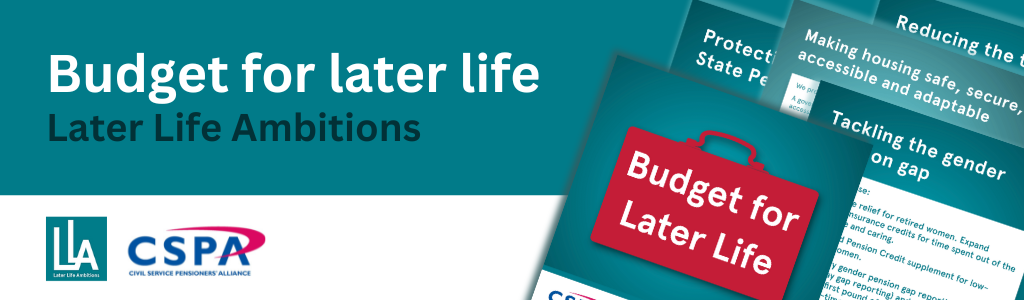
What we're calling for:
This Budget presents our plan for a fairer, more sustainable deal for older people. we urge you to stand with us and add your voice to our calls for a fair deal for living well in later life.
- Protecting the State Pension
- Reducing the tax on pensions
- Tackling the gender pension gap
- Supporting older people in the workplace
- A minimum income guarantee
- Widening access to public transport
- Making housing safe, secure, accessible and adaptable
- Supporting health and social care