
When we think about retirement, it’s natural to think about how much pension income we have coming in each month.
But there’s another question that matters just as much: how much do you actually need to live a decent life in retirement?
For retired civil servants, a Civil Service pension provides an important source of regular income, alongside the State Pension and any other income or savings. But having a pension does not mean that everyone has the same financial circumstances, or that everyone’s income will stretch to the same standard of living.
So what should we mean by a ‘decent’ retirement?
What does a decent retirement cost?
The latest Retirement Living Standards, published by Pensions UK in 2026, provide a useful starting point.
The Standards, developed by the Centre for Research in Social Policy at Loughborough University, set out three different levels of retirement living: Minimum, Moderate and Comfortable. They are based on research into what members of the public think is needed for different standards of living.
For a one-person household, the current figures are:
Retirement standard | Annual spending |
Minimum | £13,900 |
Moderate | £32,700 |
Comfortable | £45,400 |
For two people sharing a household, the figures are £22,500, £45,400 and £62,700 respectively.
These figures are spending benchmarks, rather than Government-set income levels. They are intended to give people a picture of what different standards of retirement might look like.
And the word minimum is worth considering.
The Minimum Retirement Living Standard is described as covering all your needs, with some left over for fun. It isn’t intended to describe a life where someone can simply pay their bills and nothing more.
It includes things such as a week’s holiday in the UK, eating out once a month and some affordable leisure activities.
That matters because a decent retirement should be about more than survival.
More than paying the bills
The costs of retirement aren’t limited to food and household bills.
People need to be able to travel, keep in touch with family and friends, replace clothes and household goods, enjoy hobbies and have some opportunities to socialise and take part in their communities.
These things can sometimes be dismissed as luxuries. But being able to stay socially connected, active and independent is an important part of a good quality of life.
The Retirement Living Standards recognise this. The three levels reflect increasing levels of financial security and flexibility, rather than simply different amounts of money needed to keep the lights on.
Of course, everyone’s circumstances are different.
Housing costs can make a substantial difference to what someone needs to live on. Someone who owns their home outright will have different costs from someone renting. A person living alone will have different household costs from a couple, while someone with additional mobility or care needs may have significant extra expenses.
The Standards therefore aren’t intended to tell every individual exactly how much they need.
But they do provide a useful benchmark for asking a bigger question: what should a decent retirement look like?
Retirement security isn't the same for everyone
The Civil Service Pension Scheme gives many of our members an important foundation for retirement.
But the fact that someone has an occupational pension doesn’t automatically mean they have the same standard of living as another pensioner.
Pension income varies, as do people’s circumstances. Some people have higher housing or care costs. Some live alone. Some may have spent periods working part-time or away from the workplace because of caring responsibilities. Others may have additional financial commitments.
And costs can change over time.
A retirement income that once felt comfortable may become harder to manage as household bills, food, transport and other costs rise.
This is why looking at what people can afford, rather than simply whether they receive a pension, is so important.
Pensioner poverty is still a reality
For some pensioners, meeting the essentials is already difficult.
The latest Government figures show that 1.5 million pensioners were living in material deprivation in the financial year ending 2025, equivalent to 12% of all pensioners. Material deprivation measures whether people are going without a range of goods, services and experiences considered necessary for an acceptable standard of living.
The same Government statistics show that 14% of pensioners were living in relative low income after housing costs in FYE 2025.
These figures don’t mean that every pensioner experiencing financial pressure is living in poverty. Nor do they tell us what every individual needs.
What they do show is that reaching retirement age does not automatically guarantee financial security.
So what should everyone be able to expect?
We believe that everyone should be able to look forward to a retirement in which they can meet their essential costs and maintain a dignified, active and healthy standard of living.
That doesn’t mean everyone should have the same income.
It means there should be a reasonable minimum level of financial security below which nobody should fall.
This is the principle behind our call for a Minimum Income Guarantee for older people.
We believe this should cover essential costs including housing, energy and water, groceries, personal care, transport, clothing and communications, while allowing something for leisure and social activities.
It should be informed by evidence such as the Retirement Living Standards and the Joseph Rowntree Foundation’s Minimum Income Standards, and reviewed regularly so that it continues to reflect changing costs and the way people live.
A Minimum Income Guarantee would provide a foundation. Occupational and personal pensions would continue to provide additional income and security.
CSPA's view
A decent retirement shouldn’t simply mean having enough money to survive until the next pension payment.
It should mean being able to meet your essential costs, stay connected with the people around you, remain active and independent, and have some money left to enjoy life.
CSPA believes that should be the minimum we expect for everyone in later life. That’s why as part of Later Life Ambitions we are calling for a Minimum Income Guarantee that reflects the real cost of living and gives every older person the financial security they deserve.
Later Life Ambitions
Later Life Ambitions brings together the collective voices of over a quarter of a million pensioners through the National Federation of Occupational Pensioners, the Civil Service Pensioners’ Alliance, and the National Association of Retired Police Officers Association.
We aim to encourage today’s decision makers to confront the challenges of tomorrow.
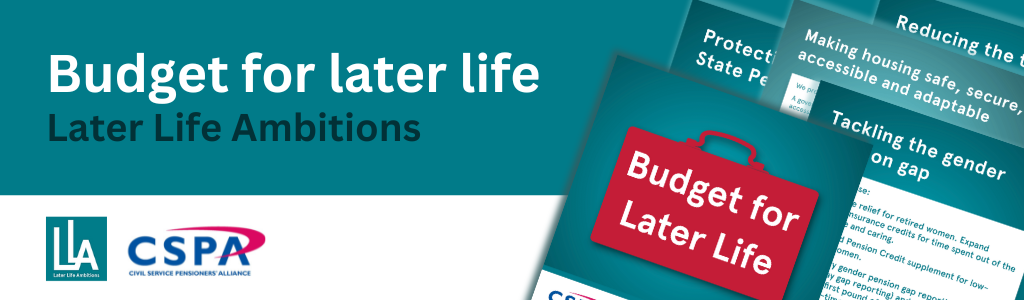
What we're calling for:
This Budget presents our plan for a fairer, more sustainable deal for older people. we urge you to stand with us and add your voice to our calls for a fair deal for living well in later life.
- Protecting the State Pension
- Reducing the tax on pensions
- Tackling the gender pension gap
- Supporting older people in the workplace
- A minimum income guarantee
- Widening access to public transport
- Making housing safe, secure, accessible and adaptable
- Supporting health and social care