
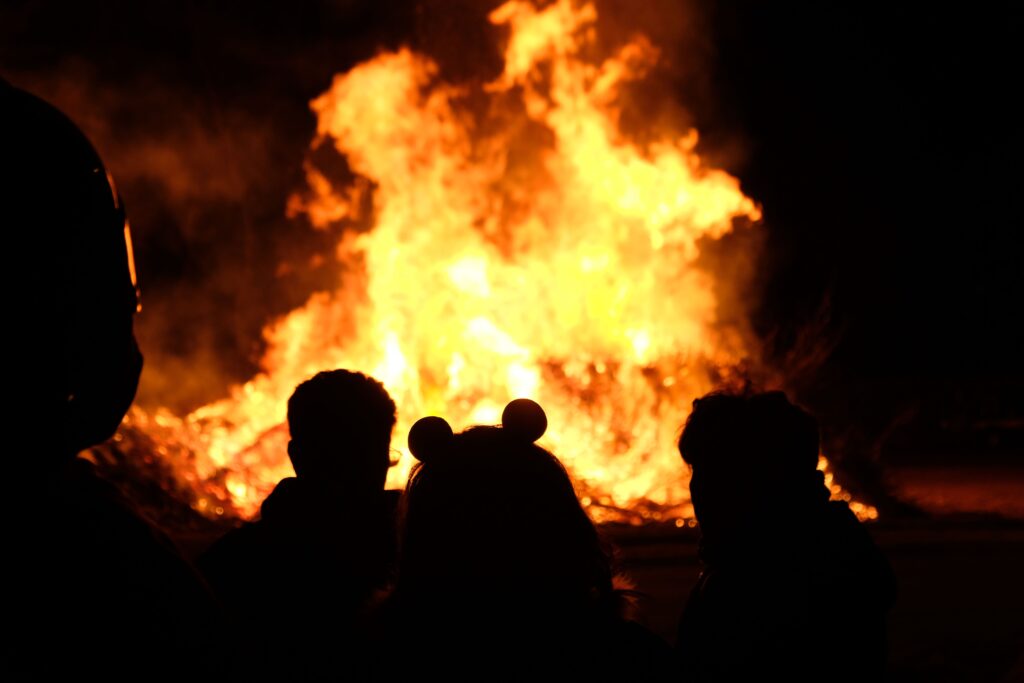
For me, Bonfire Night means standing outside in the cold, watching fireworks through a cloud of smoke and trying to keep warm around a bonfire.
Growing up in the 1980s, 5 November felt a bit different than it does today. There would be a bonfire, fireworks, sparklers and, almost inevitably, a Guy made from old clothes and stuffed with newspaper. For a few weeks beforehand, children would be out with their homemade Guys asking passers-by for “a penny for the Guy”. You knew what the evening was about, even if you weren’t particularly interested in the history.
There were no safety barriers around the bonfire, and probably considerably fewer health and safety considerations than there are today. Looking back, some of it was probably more than a little risky. But there was something wonderfully communal about everyone turning up with their Guy, standing around the bonfire and waiting for the fireworks to start.
As I now take my own children to Bonfire Night I notice just how much things had changed. The organised displays are bigger and better, the crowds were more carefully managed and there was much more emphasis on safety. But you don’t necessarily see a Guy, and sometimes there isn’t even much of a bonfire.
These days, in some places, Bonfire Night has essentially become an excuse for a fireworks display.
Which raises an interesting question: have we gradually forgotten the reason for it all?
The story behind 5 November dates back to 1605, when Guy Fawkes was caught guarding barrels of gunpowder beneath the Houses of Parliament with the aim of assination King James I.
Following the failure of the Gunpowder Plot, 5 November became an annual day of thanksgiving, with bonfires lit to mark the survival of the King. Over time, the political and religious meaning faded and the traditions evolved. Fireworks became part of the celebrations, and the figure of the Guy became a familiar feature.
Of course, very few people today are gathering around a bonfire to contemplate the survival of James I. For most of us, Bonfire Night is simply part of autumn: fireworks, cold weather, hot food and the unmistakable smell of smoke.
But I do wonder whether something has been lost along the way. You don’t necessarily need to agree with the politics or religion behind the original event, but knowing why we mark particular days is part of what makes traditions interesting.
Perhaps that’s why I still have a soft spot for the slightly scruffy Guy, the enormous community bonfire and the rather less impressive fireworks of my childhood. They may not have been as spectacular as today’s displays, but at least you knew exactly what you were there for.
So this 5 November, when the fireworks start, spare a thought for the reason behind the rockets and sparklers. And if you happen to see a Guy sitting on top of a bonfire, perhaps that’s worth a photo too. They seem to be becoming a rather rare sight.